Part 2: Fiduciary Duties to Shareholders, Partners, and Members
27 What is a benefit corporation?
Many individuals seeking to earn a living also care about satisfying a social mission. A “benefit corporation” is a legal structure that attempts to enable this. Like a regular corporation, a benefit corporation incorporates under state law and enjoys limited liability and can raise capital through shareholders. Unlike a typical corporation, a benefit corporation has specific legal duties other than increasing shareholder profit.
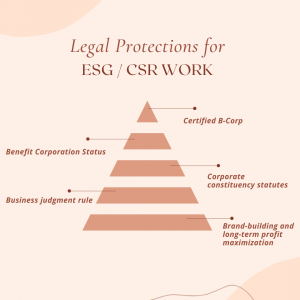
Consider Idaho’s benefit corporation act, linked here, with excerpts below. The law requires that the board of directors consider the effect of their actions and inactions on shareholders, employees, suppliers, customers, community, local and global environment, and the short and long-term interests of the benefit corporation. This is a remarkably different set of legal requirements than those faced by a typical corporation:
30-2007. STANDARD OF CONDUCT FOR DIRECTORS. (1) In discharging the duties of their respective positions and in considering the best interests of the benefit corporation, the board of directors, committees of the board and individual directors of a benefit corporation shall consider the effects of
any action or inaction on:
-
-
- The shareholders of the benefit corporation;
- The employees of the benefit corporation;
- The subsidiaries and suppliers of the benefit corporation;
- The interests of customers as beneficiaries of the general public benefit or specific public benefit purposes of the benefit corporation;
- Community and social factors, including those of each community in which offices or facilities of the benefit corporation, its subsidiaries, or its suppliers are located;
- The local and global environment;
- The short-term and long-term interests of the benefit corporation, including benefits that may accrue to the benefit corporation from its long-term plans and the possibility that these interests may be best served by the continued independence of the benefit corporation; and
- The ability of the benefit corporation to accomplish its general public benefit purpose and any specific public benefit purpose.
-
(2) In discharging the duties of their respective positions and in considering the best interests of the benefit corporation, the board of directors, committees of the board and individual directors of a benefit corporation may also consider any other pertinent factors or the interests of any group that they deem appropriate.
Later, the law specifically states that considering these factors does not constitute a violation of the typical requirement that a board of directors acts in good faith and in the best interests of the company.
An example benefit corporation is King Arthur Baking, an employee-owned company with a mission to “inspire connections and community by spreading the joy of baking.” Benefit corporation status allows them to host community events and programs without concern that shareholder value is not being maximized. At the same time, they are a profit-seeking entity, not a non-profit corporation. You can access one of their Annual Reports here, which notes they “believe in doing the right thing for all stakeholders” by measuring “a triple bottom line–people, planet, and profit.” They note that they “carry on our centuries-old heritage of stewardship through the quality of our brand, and the steps we take to preserve the vitality of our community and the earth on which we live.”
This mission has several concepts we will cover later, such as stakeholders and the triple bottom line. Note for now the mix of language. On one hand, “profit” and “quality of our brand”, concepts common to every for-profit entity. On the other hand, noting “stakeholders”, “people”, “planet”, and “community” are broader concerns which may conflict with traditional notions of profit maximization. Benefit corporation status thus brings corporations “full circle”, back to their roots in express public purposes before being allowed the privilege of incorporation.

Another important aspect of certified B Corps is that they must maintain their standards over time, not just during the initial certification. Companies are required to re-certify every three years, ensuring they continue to meet evolving social and environmental benchmarks. This ongoing accountability discourages companies from using certification as a one-time marketing tool and instead promotes continuous improvement. This process also reinforces ethical business practices by emphasizing consistency and ongoing accountability. Regular evaluations and measurable standards push companies to continually assess how their decisions affect stakeholders such as employees, communities, and the environment. In this way, ethical considerations become part of everyday operations rather than something only addressed when it benefits the company’s image.
Ben & Jerry’s is an example of how this works in practice. The company focuses on using its business to support social and environmental causes (such as regenerative agriculture and animal welfare), and it continues to update its efforts instead of treating certification as a one-time accomplishment. This is reflected in an increasing B-Corp certification “B Impact” score over time, from 88.7 in 2012 to 96 in its most recently reported score.

Exercises
- Find a corporation structured as a benefit corporation. What is their mission? Would they be able to accomplish this mission with benefit corporation status?